
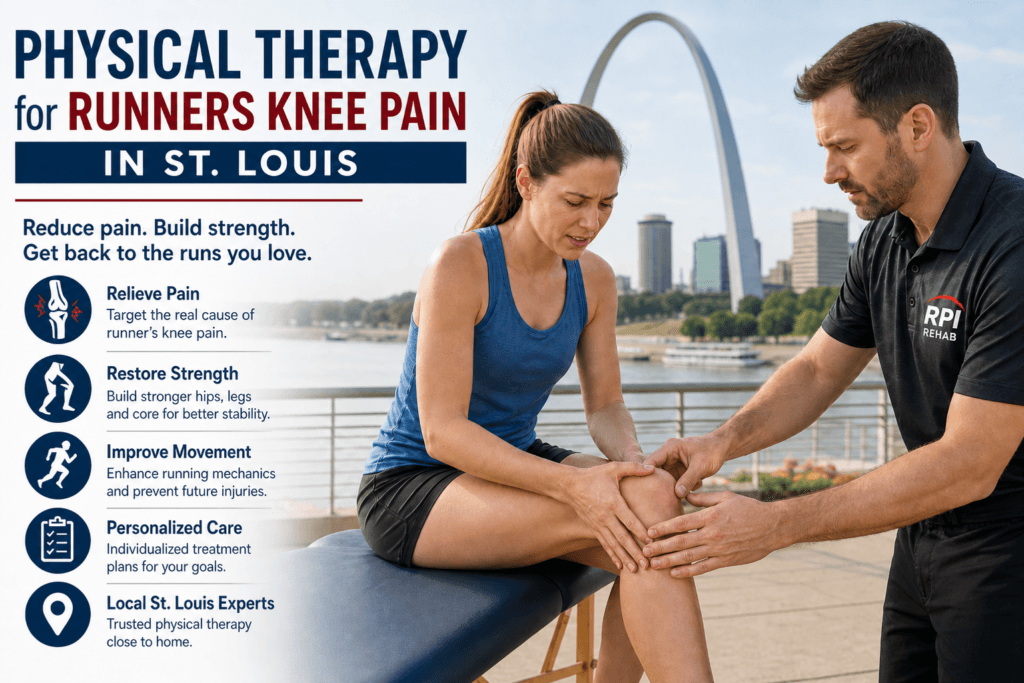
Understanding Runner’s Knee and Why It Affects So Many St. Louis Runners
If you are searching for physical therapy for runners knee pain in St. Louis, there is a good chance your knee pain started quietly. Maybe it showed up after a long run in Forest Park. Maybe it appeared during hill training, speed work, or a weekend race. At first, it may have felt like a dull ache around the front of the knee. Then it became harder to ignore.
Runner’s knee is commonly associated with patellofemoral pain syndrome. This often involves pain around or behind the kneecap. It can become more noticeable when running, climbing stairs, squatting, or sitting with bent knees. NIH/NCBI notes that strengthening the thigh and hip muscles can help relieve pain in the front of the knee. That is one reason physical therapy often plays such an important role in recovery. NIH/NCBI explains runner’s knee and strengthening exercises here.
At RPI, we often see runners who are frustrated because their pain does not match their effort. They may have reduced mileage, changed shoes, stretched more, or rested for several days. Still, the pain returns as soon as they start running again. That can feel discouraging, especially when running is tied to stress relief, fitness, social connection, or race goals.
The key is understanding that runner’s knee is not always just a “knee problem.” It may involve hip weakness, poor movement control, overtraining, limited mobility, or changes in running mechanics. A physical therapy plan looks at the entire chain. That includes the foot, ankle, knee, hip, core, and running demands.
RPI has also discussed runner’s knee as one of the common issues runners face, especially when strength, flexibility, and training load are not balanced. You can read more about related running injuries on RPI’s page about common running injuries and prevention methods.
Why Rest Alone Usually Does Not Solve Runner’s Knee
Many runners try to fix knee pain by taking a week off. Sometimes that helps temporarily. The pain calms down, swelling or irritation decreases, and walking feels normal again. But when running resumes, the same pain often comes back. That happens because rest may reduce symptoms without correcting the underlying cause.
Runner’s knee often develops from repeated stress across the patellofemoral joint. When the kneecap does not tolerate training load well, pain can build over time. Johns Hopkins Medicine notes that prevention can include gradual activity progression, proper footwear, warming up, stretching, and avoiding overstressing the knees. Those habits matter, but they work best when paired with a targeted strengthening and movement plan. Johns Hopkins Medicine provides an overview of patellofemoral pain syndrome here.
A common example is the runner who rests for ten days before a race. The knee feels better during normal activities. Then race day arrives, adrenaline kicks in, and the runner pushes through several miles. By the next morning, stairs are painful again. The issue was not that rest failed. The issue was that rest never rebuilt the strength, control, or tissue tolerance needed for running.
Physical therapy takes a more complete approach. At RPI, the first goal is to understand what is driving the pain. We look at how the knee moves, how the hip supports the leg, how the foot strikes the ground, and how training volume changed. We also consider whether the pain is aggravated by hills, speed work, uneven surfaces, or long periods of sitting.
That evaluation matters because no two runners are exactly the same. One person may need hip strengthening. Another may need quad control. Another may need gait adjustments or a slower return-to-run plan. The right plan should fit the runner, not just the diagnosis.
How Physical Therapy Evaluates the Real Cause of Knee Pain
Good physical therapy starts with an assessment, not a generic exercise sheet. For runners, that assessment should look beyond the kneecap. The therapist needs to understand how the body absorbs force, controls motion, and handles repeated impact.
At RPI, a runner’s knee evaluation may include strength testing, mobility testing, balance work, gait observation, and a review of training history. We want to know when the pain started, where it is located, what makes it worse, and what makes it better. We also ask about recent changes. Did mileage increase? Did the runner add hills? Did shoes change? Did strength training stop? Did the runner start running on more concrete?
These details often reveal the pattern. For example, someone training for a half marathon may increase long runs too quickly. Another runner may have strong quads but weak hip stabilizers. Another may feel fine during easy runs but flare up after intervals. Each case points toward a different treatment emphasis.
The physical therapist may also look at single-leg movements. Running is essentially a series of single-leg landings. If the hip drops, the knee collapses inward, or the foot loses control, the kneecap may experience added stress. These movement patterns can be subtle. Many runners do not feel them happening.
This is where runner’s knee physical therapy in St. Louis becomes valuable. A therapist can connect symptoms to movement, then build a plan that addresses the actual deficits. The goal is not just to make pain disappear for a few days. The goal is to help the runner tolerate training again.
A smart evaluation also helps rule out concerns that may require medical referral. Severe swelling, locking, instability, trauma, or worsening pain should be addressed carefully. Physical therapy is most effective when the plan matches the condition.
Strengthening the Hip, Knee, and Core for Better Running Mechanics
Strengthening is one of the most important parts of runner’s knee recovery. Many runners assume they need only more stretching. Stretching can help in some cases, but strength is often the missing piece. The knee depends on support from the hip, thigh, calf, and core. If those areas cannot control running forces, the knee may take more stress than it should.
NIH/NCBI specifically notes that strengthening the knee, thigh, and hip muscles can stabilize the kneecap and relieve pain. That is why physical therapy often includes hip abduction work, glute strengthening, quad strengthening, step-down training, and single-leg control exercises. NIH/NCBI discusses these strengthening principles here.
Cleveland Clinic also emphasizes strengthening and stretching exercises for patellofemoral pain syndrome. It recommends warming up first with light activity before exercise. That matters because cold, stiff tissues may not tolerate strengthening well. Cleveland Clinic outlines several runner’s knee exercises here.
At RPI, strengthening usually progresses in stages. Early exercises may focus on controlled, low-irritation movements. As symptoms improve, the program becomes more functional. A runner may progress from basic hip work to squats, step-downs, lunges, balance drills, and eventually running-specific loading.
This progression matters. If the exercise is too easy, it may not create enough adaptation. If it is too aggressive, it may flare the knee. Physical therapy helps find the right dosage. That means the right exercise, at the right intensity, at the right time.
A common patient story involves a runner who says, “I thought I was strong because I run.” Running does build endurance, but it does not automatically create balanced strength. Distance running is repetitive. It can expose weakness rather than fix it. A targeted strength plan helps fill those gaps.
The Role of Running Form and Training Load
Runner’s knee is often tied to training load. That does not mean the runner did anything wrong. It simply means the knee may have been asked to handle more stress than it was ready for. This can happen during race training, after time off, or when returning from another injury.
Training load includes mileage, pace, hills, terrain, frequency, and recovery. A runner who increases mileage and adds speed work in the same month may overload the knee. A runner who switches from treadmill running to hilly outdoor routes may also feel symptoms. Even small changes can matter when repeated over thousands of steps.
Physical therapy can help runners adjust load without stopping completely. In some cases, the plan may include temporary mileage reduction, walk-run intervals, softer surfaces, fewer hills, or lower-intensity runs. The goal is not always total rest. The goal is finding the level of activity the knee can tolerate while recovery continues.
Running form can also play a role. Some runners overstride, land with excessive braking force, or lack hip control during stance. Others may have cadence issues or poor trunk control. A physical therapist can observe these mechanics and suggest practical changes. These changes should be modest, not overwhelming.
At RPI, we want runners to understand their pain instead of fear it. A mild ache during rehab may not always mean damage. But sharp pain, worsening pain, swelling, or altered gait should be taken seriously. Education helps runners make better choices during training.
This is especially important for St. Louis runners because terrain varies. Running in Forest Park, Clayton, Creve Coeur, or city neighborhoods can involve hills, pavement, uneven sidewalks, and changing weather. The body needs enough strength and control to adapt to those demands.
Manual Therapy, Mobility, and Soft Tissue Treatment
Strengthening is essential, but it is not the only tool. Some runners also benefit from manual therapy, mobility work, and soft tissue treatment. These methods can help reduce muscle tension, improve movement, and make exercise more comfortable.
Runner’s knee may be influenced by stiffness in the hips, calves, ankles, or quadriceps. If the ankle does not move well, the knee may compensate. If the hip is restricted, the leg may not align efficiently. If the quadriceps or IT band region feels tight, the runner may feel more pressure around the kneecap.
Manual therapy is not a standalone cure. It works best when paired with active rehabilitation. A therapist may use hands-on techniques to improve mobility, then reinforce that movement with strengthening. This combination helps the body use the new range of motion.
RPI also offers treatment options that may support recovery in selected cases. For example, deep tissue laser therapy may be used as part of a broader plan for pain relief and tissue recovery. RPI explains that patients may observe positive results after several sessions when laser therapy is combined with regular physical therapy. You can read more about RPI’s approach to deep tissue laser therapy.
Some runners with muscle spasms, trigger points, or persistent soft tissue tension may also benefit from other approaches. RPI offers trigger point dry needling, which is described as a treatment for muscle spasms and tension associated with strains, arthritis, and other conditions.
The important point is that treatment should be individualized. A runner with mild weakness does not need the same plan as a runner with chronic pain and significant mobility restrictions. Physical therapy helps match the tools to the problem.
When Aquatic Therapy May Help Runners With Knee Pain
Some runners are eager to stay active but cannot tolerate normal running. In those cases, aquatic therapy may be useful. Water reduces weight-bearing stress while still allowing movement, strengthening, and conditioning.
This can be helpful when knee pain is too irritable for land-based exercise. A runner may be able to perform walking drills, balance work, gentle strengthening, or range-of-motion activities in water before progressing to land. The reduced load can make early rehab less painful and more productive.
RPI notes that aquatic therapy may be used for several conditions, including knee pain, hip pain, gait difficulty, arthritis, and post-surgical issues. You can learn more about RPI’s page on the benefits of aquatic therapy.
For runners, aquatic therapy can also help preserve confidence. Pain can make athletes feel like they are losing fitness every day. Water-based movement gives them a way to keep moving while respecting symptoms. That can be emotionally important, especially for runners preparing for an event.
A typical progression might begin with aquatic walking, gentle mobility, and low-impact strengthening. Then the runner may move to land-based exercises, controlled single-leg work, and eventually walk-run intervals. The exact timeline depends on symptoms, strength, and goals.
Aquatic therapy is not necessary for every case of runner’s knee. Many runners can begin with land-based rehab. But for the right patient, it can bridge the gap between painful activity and full training.
A good therapist will choose aquatic therapy based on need, not novelty. The purpose is to reduce irritation, build capacity, and help the runner move forward without repeatedly flaring the knee.
Returning to Running Without Repeating the Same Injury Cycle
The return-to-running phase is where many people make mistakes. Once the knee starts feeling better, it is tempting to jump back into normal mileage. That is understandable, but it can restart the same pain cycle.
A safe return usually requires gradual loading. This may include walk-run intervals, short easy runs, rest days between runs, and careful symptom tracking. The runner should avoid adding too many variables at once. Mileage, speed, hills, and frequency should not all increase together.
For example, a runner may start with one minute of running and two minutes of walking for several rounds. If symptoms stay controlled, the running intervals increase. Later, the runner may add distance. Speed work and hills usually return later. This type of structure helps the knee adapt.
Physical therapy also helps runners understand acceptable symptoms. Some soreness may be normal during strengthening. But pain that worsens during the run, changes running form, or lingers into the next day may mean the load is too high. Tracking symptoms gives the therapist useful feedback.
RPI’s role is to guide that progression. We do not want runners guessing their way back. We want them to understand what their knee can handle and how to build from there.
A common scenario is the runner who says, “I felt great, so I ran five miles.” Unfortunately, feeling better does not always mean the tissue is ready for full training. Rehabilitation builds a foundation first. Then running volume returns.
This approach is especially useful for runners with specific goals. Whether someone wants to finish a 5K, return to marathon training, or simply run pain-free again, the plan should match that goal.
How RPI Helps St. Louis Runners Build a Personalized Recovery Plan
RPI works with patients across the St. Louis area who want practical, individualized rehabilitation. For runners, that means treatment should consider both pain relief and performance. The goal is not only to reduce symptoms. The goal is to help the runner move better, train smarter, and reduce the risk of recurrence.
A personalized plan may include strengthening, mobility work, manual therapy, education, gait review, balance training, and return-to-run programming. It may also include supportive treatments like aquatic therapy, laser therapy, or dry needling when appropriate. The plan changes as the runner improves.
This matters because runner’s knee can be stubborn. A generic plan may help for a short time, but long-term improvement usually requires specificity. The therapist needs to know what kind of running the patient does, what surfaces they use, what shoes they wear, and what goals they have.
At RPI, we also understand that pain affects more than training. Runners often use running to manage stress, maintain routine, and connect with others. When knee pain interrupts that, it can feel like losing part of daily life. Compassion matters in that process.
One runner may need reassurance that they are not “broken.” Another may need accountability to stop pushing too fast. Another may need a structured plan because they are overwhelmed by conflicting advice online. Physical therapy gives them a clearer path.
RPI has St. Louis-area locations in Clayton and Creve Coeur. You can view clinic details on the RPI page for St. Louis locations.
When to Seek Physical Therapy for Runner’s Knee Pain
Some runners wait too long before getting help. They assume knee pain is normal, especially during training. But pain that keeps returning deserves attention. The sooner the cause is identified, the easier it may be to correct.
You should consider physical therapy if knee pain lasts more than a few runs, worsens with stairs, affects your running form, limits mileage, or returns after rest. You should also seek help if you are changing your stride to avoid pain. Compensating can create problems elsewhere.
Runner’s knee is usually manageable, but ignoring it can extend the recovery timeline. Small issues can become larger when training continues without adjustment. Physical therapy helps interrupt that pattern.
It is also important to recognize red flags. Significant swelling, locking, instability, trauma, fever, or severe pain should be evaluated by a medical professional. Physical therapists can help determine whether symptoms fit a typical runner’s knee pattern or need further medical review.
For most runners, the best time to get help is before pain controls the training plan. If you are already negotiating with your knee before every run, that is a sign. You should not have to guess whether today’s workout will make tomorrow difficult.
At RPI, our goal is to help runners understand the source of pain and return to activity with confidence. That means building strength, improving mechanics, and creating a realistic progression. It also means listening to the runner’s goals.
Conclusion: Getting Back to Running Starts With the Right Plan
Runner’s knee can be frustrating because it often appears gradually and lingers longer than expected. But it does not have to end your running routine. With the right physical therapy plan, many runners can reduce pain, rebuild strength, and return to training more safely.
The most effective approach looks beyond the knee itself. It considers the hips, feet, ankles, core, training load, running mechanics, and recovery habits. That is why physical therapy for runners knee pain in St. Louis can be so valuable. It gives runners a structured path instead of guesswork.
At RPI, we help runners identify what is driving their pain and build a plan that fits their goals. Whether you are training for a race or simply want to run comfortably again, the first step is understanding the problem.
To schedule an appointment or find the RPI location closest to you, visit RPI’s St. Louis locations page.