
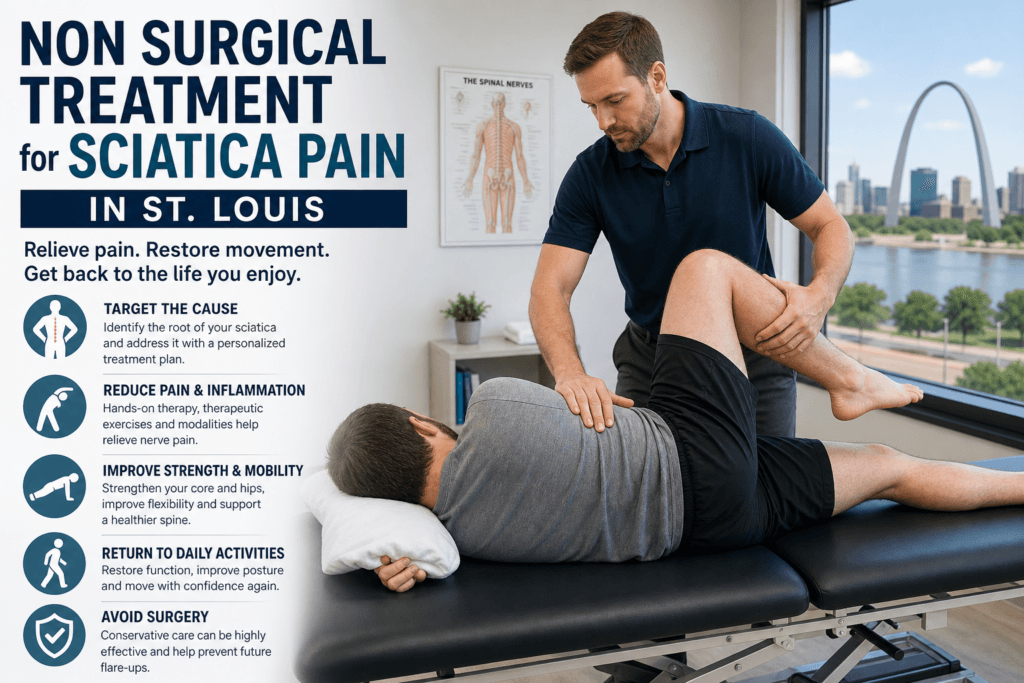
Understanding Sciatica and Why It Can Disrupt Daily Life
If you are searching for non surgical treatment for sciatica pain in St. Louis, you may already know how frustrating sciatic nerve pain can feel. It can start as a dull ache in the lower back or buttock. Then it may travel down the leg, sometimes reaching the calf, foot, or toes. For some people, it feels sharp and electric. For others, it creates burning, tingling, numbness, or weakness.
Sciatica is not simply ordinary back pain. MedlinePlus explains that sciatica is a symptom of a problem involving the sciatic nerve, which is the largest nerve in the body. It can cause pain, weakness, numbness, or tingling that starts in the lower back and extends down the leg. It is often felt on one side of the body. MedlinePlus offers a helpful overview of sciatica here.
At RPI, we often meet patients who say the same thing: “I thought it would go away, but it keeps coming back.” One patient may feel pain after sitting at a desk all day. Another may notice symptoms after driving, lifting, walking, or standing too long. Sciatica can interfere with work, sleep, exercise, and simple daily tasks.
The good news is that surgery is not the only option. In many cases, conservative care can help reduce symptoms and improve function. Physical therapy focuses on identifying what is irritating the nerve, improving movement, restoring strength, and helping patients return to daily activity with more confidence.
RPI treats back and spine pain, including sciatica, through clinician-guided manual therapy and exercise intervention. You can learn more on RPI’s page for back and spine pain treatment.
Why Sciatica Happens
Sciatica usually happens when the sciatic nerve or the nerve roots that form it become irritated, compressed, or inflamed. This irritation may come from a herniated disc, spinal stenosis, degenerative disc changes, muscle tension, or joint-related problems in the lower back and pelvis.
Johns Hopkins Medicine describes sciatica as pain that originates along the sciatic nerve. This nerve extends from the back of the pelvis down the back of the thigh. It is the main nerve in the leg and the largest nerve in the body. Johns Hopkins Medicine explains sciatica here.
The location of symptoms can vary. Some people feel most of the pain in the low back. Others feel it mainly in the buttock, hip, hamstring, calf, or foot. This is one reason sciatica can be confusing. A patient may think they have a hamstring injury, hip problem, or calf strain when the true source is nerve irritation from the lower spine.
Physical therapy starts by looking at the full pattern. Where does the pain travel? What positions make it worse? Does sitting increase symptoms? Does walking help? Is there numbness, tingling, or weakness? Are symptoms better when bending forward or extending backward?
These answers matter because not every case of sciatica should be treated the same way. One person may need gentle mobility work. Another may need core stabilization. Another may need hip strengthening, posture changes, or nerve mobility exercises. Effective sciatica pain treatment in St. Louis begins with understanding the cause, not just chasing symptoms.
Why Non Surgical Treatment Is Often the First Step
Many patients hear the word “sciatica” and immediately worry about surgery. That fear is understandable, especially when the pain travels down the leg. However, surgery is not always necessary. Many people improve with conservative treatment, especially when symptoms are addressed early and consistently.
Mayo Clinic notes that, for most people, sciatica responds to self-care measures. It also explains that although a day or so of rest may provide relief, staying inactive can make symptoms worse. Mayo Clinic discusses sciatica diagnosis and treatment here.
This is an important point. Many people try to rest their way out of sciatica. Rest may calm symptoms temporarily, but it often does not correct the movement problem, weakness, stiffness, or nerve sensitivity that caused the flare-up. When normal activity resumes, symptoms may return.
Physical therapy offers a more active approach. The goal is not to push through pain blindly. The goal is to find the safest way to move, strengthen, and reduce irritation. A treatment plan may include posture education, gentle stretching, manual therapy, strengthening, nerve glides, gait work, and gradual return to activity.
At RPI, we also consider the patient’s lifestyle. A desk worker, caregiver, runner, retiree, and construction worker may all need different strategies. The treatment plan should match the person’s daily demands.
Non surgical care is especially valuable because it helps patients understand their symptoms. When someone knows which movements help and which ones aggravate pain, they can make better choices. That confidence can reduce fear and improve recovery.
Physical Therapy Evaluation for Sciatica
A strong physical therapy plan begins with a detailed evaluation. Sciatica can have several causes, so the first visit should not feel like a generic routine. The therapist needs to understand the patient’s symptoms, activity level, medical history, and goals.
At RPI, an evaluation may include posture assessment, spinal mobility testing, strength testing, flexibility screening, balance review, and movement observation. The therapist may ask the patient to bend, walk, sit, stand, or perform certain movements to see how symptoms respond.
This process helps identify patterns. Some patients feel worse with sitting and better with standing. Others feel better leaning forward. Some feel pain with extension. Others have symptoms that change with walking distance. These details help guide treatment.
The therapist may also assess the hip, pelvis, hamstrings, calves, and core. Sciatica often involves more than one structure. Tight hips, weak glutes, limited spinal mobility, poor core endurance, or altered walking mechanics can all contribute to recurring symptoms.
RPI’s approach to back pain includes targeted therapy, mobility work, strengthening, and hands-on assessment. In an RPI article on chronic back pain, the clinic explains that therapy can help patients regain mobility, reduce pain, and restore confidence in movement. You can read more in RPI’s article on physical therapy in Saint Louis for chronic back pain.
The evaluation also helps determine whether a patient needs medical referral. Severe weakness, loss of bladder or bowel control, progressive numbness, major trauma, fever, or unexplained weight loss should be addressed urgently. Physical therapy is effective for many cases, but safety always comes first.
Manual Therapy and Mobility Work
Manual therapy can be an important part of non surgical sciatica treatment. When joints, muscles, and soft tissues are stiff or restricted, the body may compensate in ways that irritate the sciatic nerve. Hands-on therapy can help improve movement, reduce guarding, and make exercise more comfortable.
Manual therapy may include gentle spinal mobilization, soft tissue work, hip mobility techniques, or stretching support. The purpose is not to “force” the spine into place. The purpose is to improve how the body moves and reduce unnecessary stress on irritated tissues.
For example, a patient may have stiffness in the lumbar spine and tightness through the hip. That combination can increase strain during walking, bending, or lifting. Manual therapy may help restore motion, while exercise helps maintain that motion.
This is where physical therapy differs from passive pain relief. A massage or heat pack may feel good temporarily. Physical therapy connects relief with function. After mobility improves, the therapist teaches the patient how to move better, strengthen better, and avoid repeated flare-ups.
Some patients feel nervous about movement because they fear making the pain worse. Manual therapy can help reduce that fear by making movement feel safer. When paired with education, it can help patients understand that the body is capable of recovery.
At RPI, manual therapy is often combined with exercise intervention. That combination matters. Mobility without strength may not last. Strength without mobility may feel uncomfortable. A balanced plan gives patients both symptom relief and long-term support.
Strengthening the Core, Hips, and Lower Body
Strengthening is one of the most important parts of sciatica recovery. The lower back does not work alone. It depends on support from the core, hips, glutes, pelvis, and legs. When these areas are weak or poorly coordinated, the lower spine may absorb more stress.
A physical therapy strengthening plan may include exercises for the deep core, glute muscles, hip stabilizers, hamstrings, and lower back. The exact exercises depend on the patient’s symptoms and tolerance. Early exercises may be gentle. Later exercises may become more functional and challenging.
Common starting points may include pelvic tilts, bridges, modified planks, bird-dogs, side-lying hip exercises, and controlled sit-to-stand work. As symptoms improve, patients may progress toward lunges, step-ups, loaded carries, and lifting mechanics.
RPI’s article on targeted physical therapy for back pain notes that lumbar stabilization exercises, including bird-dogs, bridges, and modified planks, may help activate muscles that support the spine. It also discusses flexibility training for tight hamstrings and hip flexors. You can read more in RPI’s article on targeted physical therapy in Creve Coeur for back pain.
The key is progression. Many patients start with exercises that are either too easy or too aggressive. If the exercise is too easy, it may not build capacity. If it is too difficult, it may flare symptoms. A therapist adjusts the plan based on pain response, strength, and daily function.
A patient may begin by learning how to brace the core while breathing normally. Then they may practice hip hinging. Later, they may work on lifting groceries, climbing stairs, walking longer distances, or returning to exercise. Strength should serve real life.
Nerve Mobility and Movement Re-Training
Sciatica often involves nerve sensitivity. When a nerve is irritated, it may not tolerate normal movement well. This can create symptoms during sitting, bending, stretching, or walking. Nerve mobility exercises may help the nerve move more comfortably through surrounding tissues.
These exercises are sometimes called nerve glides or nerve flossing. They are not the same as aggressive stretching. In fact, overstretching an irritated nerve may make symptoms worse. Nerve mobility work should be controlled, gentle, and matched to the patient’s response.
A therapist may also work on movement re-training. Many patients with sciatica change how they move without realizing it. They may avoid bending, shift weight to one side, shorten their stride, or tense their back muscles. These protective habits may help briefly, but they can also create more stiffness and pain over time.
Movement re-training helps patients regain confidence. A therapist may teach safer bending mechanics, better sitting posture, improved walking patterns, or strategies for getting in and out of a car. These changes can make daily life less painful.
This kind of therapy is especially useful for St. Louis patients who spend long periods commuting, working at desks, or caring for family members. Sciatica often worsens with repeated positions. Learning how to modify those positions can reduce flare-ups.
The goal is not perfect posture every minute. That is unrealistic. The goal is movement variety, better strength, and less nerve irritation. Patients often improve when they learn how to change positions before symptoms build.
Deep Tissue Laser Therapy as Part of a Broader Plan
Some patients may benefit from supportive treatments that help manage pain while they rebuild strength and mobility. At RPI, deep tissue laser therapy may be used as one tool within a broader rehabilitation plan.
RPI describes deep tissue laser therapy as a treatment option that can support the body’s natural healing process and help patients work toward physical therapy goals. You can read more about RPI’s approach to deep tissue laser therapy in Saint Louis.
It is important to understand that supportive treatments should not replace active rehabilitation. Sciatica often requires better movement, stronger muscles, improved flexibility, and smarter activity habits. Passive treatment alone may reduce pain temporarily, but it may not prevent recurrence.
That said, pain relief can matter. When pain is high, patients may struggle to exercise, sleep, or move normally. If a treatment helps calm symptoms enough for the patient to participate more fully in therapy, it can be useful.
A patient with sciatica may start with gentle mobility, symptom management, and education. As pain decreases, the plan may shift toward strengthening and functional movement. Later, the focus may become prevention, endurance, and return to normal activity.
RPI’s role is to determine which tools fit the patient. Some people need more hands-on care. Others need more strengthening. Others need education and progression. The best plan is individualized, not one-size-fits-all.
Daily Habits That Can Help Reduce Sciatica Flare-Ups
Physical therapy sessions are important, but daily habits matter too. Sciatica often responds well when patients learn how to manage symptoms between visits. Small changes can make a meaningful difference.
Sitting posture is one example. Many people with sciatica feel worse after sitting for long periods. A therapist may suggest changing chair setup, using lumbar support, standing periodically, or adjusting workstations. The goal is to reduce sustained pressure and keep the spine moving.
Lifting mechanics also matter. Bending and twisting while lifting can irritate symptoms for some patients. Physical therapy can teach safer ways to lift laundry baskets, groceries, children, luggage, or work equipment.
Walking is another useful tool for many patients. Some people feel better with short, frequent walks. Others need to build walking tolerance gradually. The right amount depends on symptoms.
Sleep position may also play a role. A pillow between the knees, a supportive mattress, or avoiding certain positions may help some patients. Again, the best choice depends on what calms or worsens symptoms.
The biggest mistake is doing nothing for days at a time. Too much rest can increase stiffness and make the return to activity harder. Mayo Clinic notes that prolonged inactivity can make symptoms worse, even though brief rest may provide relief.
A good physical therapy plan gives patients practical rules. What should I do during a flare-up? Which exercises are safe? When should I back off? When should I progress? Those answers help patients feel less controlled by pain.
When Sciatica Needs Medical Attention
Most sciatica cases are not emergencies, but some symptoms require immediate attention. Patients should seek urgent medical care if they experience loss of bladder or bowel control, numbness in the groin or saddle area, severe progressive weakness, or symptoms after major trauma.
Patients should also speak with a medical provider if pain is severe, worsening, or not improving with conservative care. Physical therapists can help identify when symptoms fit a typical sciatica pattern and when further evaluation may be needed.
NCBI notes that sciatica is frequently misunderstood, and not all low back or radiating leg pain is true sciatica. It describes sciatica as pain or paresthesia within the sciatic nerve distribution or related lumbosacral nerve root. NCBI provides a clinical overview of sciatica here.
That distinction matters. Pain down the leg may come from nerve irritation, muscle referral, hip problems, vascular issues, or other causes. A careful evaluation helps avoid assumptions.
At RPI, we take symptom patterns seriously. If a patient’s symptoms suggest something outside the scope of physical therapy, referral is appropriate. If conservative treatment is appropriate, we build a plan around the patient’s needs and goals.
Patients should not ignore nerve symptoms that are worsening. Numbness, weakness, or increasing leg pain deserves attention. Early treatment can often help prevent the condition from becoming more limiting.
Choosing RPI for Non Surgical Sciatica Treatment in St. Louis
Choosing the right provider matters when sciatica affects your daily life. You want care that is specific, practical, and guided by a clinician who understands back and nerve pain. At RPI, treatment is built around evaluation, education, movement, and progression.
RPI helps St. Louis patients with back and spine pain, including sciatica. The clinic uses manual therapy and exercise intervention to help patients return to better function.
For many patients, the first goal is simple: reduce pain enough to move normally again. The next goal is bigger: build the strength, mobility, and confidence needed to reduce future flare-ups. This is where physical therapy becomes more than symptom relief. It becomes a long-term strategy.
A patient may begin treatment feeling guarded and frustrated. They may avoid sitting, walking, bending, or exercise. Over time, the plan helps them understand what their body can tolerate. They learn how to move without fear. They rebuild strength. They return to tasks that once felt impossible.
RPI serves patients through St. Louis-area locations, including Clayton and Creve Coeur. The locations page lists the Clayton clinic at 950 Francis Place, Suite 115, Clayton, MO 63105, and the Creve Coeur clinic at 8 Millstone Campus Drive, Suite 1000, Creve Coeur, MO 63146. You can view clinic details on RPI’s St. Louis locations page.
If sciatic nerve pain is limiting your work, sleep, exercise, or daily routine, RPI can help you explore non surgical care options. The right treatment plan can reduce pain, restore movement, and help you get back to living with more confidence.
Conclusion: Sciatica Relief Without Surgery Starts With the Right Plan
Sciatica can feel overwhelming, especially when pain travels from the back into the leg. It can make simple activities feel unpredictable. Sitting, standing, walking, lifting, or sleeping may all become difficult. But surgery is not always the first or only solution.
Non surgical treatment for sciatica pain in St. Louis focuses on reducing nerve irritation, improving movement, restoring strength, and helping patients return to daily life. Physical therapy can identify the source of symptoms, address contributing factors, and teach patients how to manage flare-ups more effectively.
At RPI, care is personalized to the patient. That may include manual therapy, mobility work, core strengthening, hip strengthening, nerve mobility, education, and supportive treatments when appropriate. The goal is not only short-term relief. The goal is better function and fewer setbacks.
To schedule care or find the nearest clinic, visit RPI’s St. Louis locations page